A KIS Studios game · Ages 13+
LoopBot
Program a little robot. Climb the tallest tower in the city. Learn to think like a coder.
A puzzle game where every floor is a tiny coding challenge. Snap command blocks together, press Run, and watch LoopBot carry out your plan, mistakes and all.
Coming soon to Android. Join the Android test to play it first.
What is LoopBot
Take the tower back, one program at a time
VANTA, a rogue salvage AI, has taken over the Meridian Spire, the tallest skyscraper in the city, floor by floor. You're LoopBot, a small maintenance robot with a big job. With PATCH talking you through it over the radio, you climb all 50 floors, one puzzle at a time, to take the tower back.
You don't steer LoopBot. You program it. Plan a route with blocks like forward, turn and jump, press Run, and see if your plan works. When it doesn't, LoopBot shows you exactly where it went wrong, so you can fix it and try again.
Real coding ideas, no jargon.
Sequences, loops, functions, if/else and while loops, introduced one at a time, so each idea clicks before the next one arrives.
Small floors, big “aha” moments.
Every floor fits on one screen. Some teach a new idea without a single word of text. Clear it in as few blocks as possible to earn all three stars.
See the real code.
Every program you build has a read-only code view. On the top floors you can switch to typing the code yourself.
Play it now
Play the demo
Floors 1 to 10, free, right here in your browser. Works with a mouse or a touchscreen.
Prefer a bigger window? Play on itch.io.
How you learn
Five zones, one idea each
Tower 1 has 50 floors. Start in the Lobby and work your way up to the Rooftop.
- Floors41 to 50
Rooftop
Pro mode: type the code yourself.
- Floors31 to 40
Control Room
Conditions: if/else and while loops that react to walls, crates and switches.
- Floors21 to 30
Workshop
Functions (F1, F2): name a routine once, use it everywhere.
- Floors11 to 20
Maintenance
Repeat loops: do more with fewer blocks.
- Floors1 to 10
Lobby
Sequences: forward, turn, jump. Plan a route step by step.
More towers in new cities are on the way.
Little things players notice
- LoopBot has moods: it blinks, looks around, chirps when it’s happy and gets nervous before a risky jump.
- Step through your program one move at a time, or speed it up 2x or 4x.
- Hints when you’re stuck, never a wall of text.
- Confetti when you nail par. Calm, kind feedback when you don’t.
- Works offline. Progress is saved on your device. No account needed.
- Respects “reduce motion” settings.
Screenshots
A look inside the tower
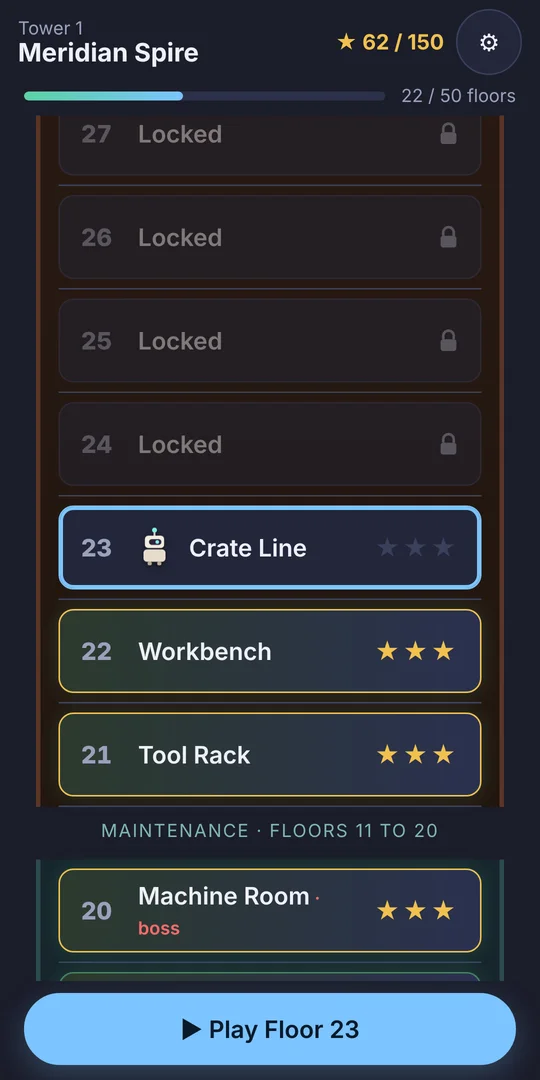
Climb 50 floors 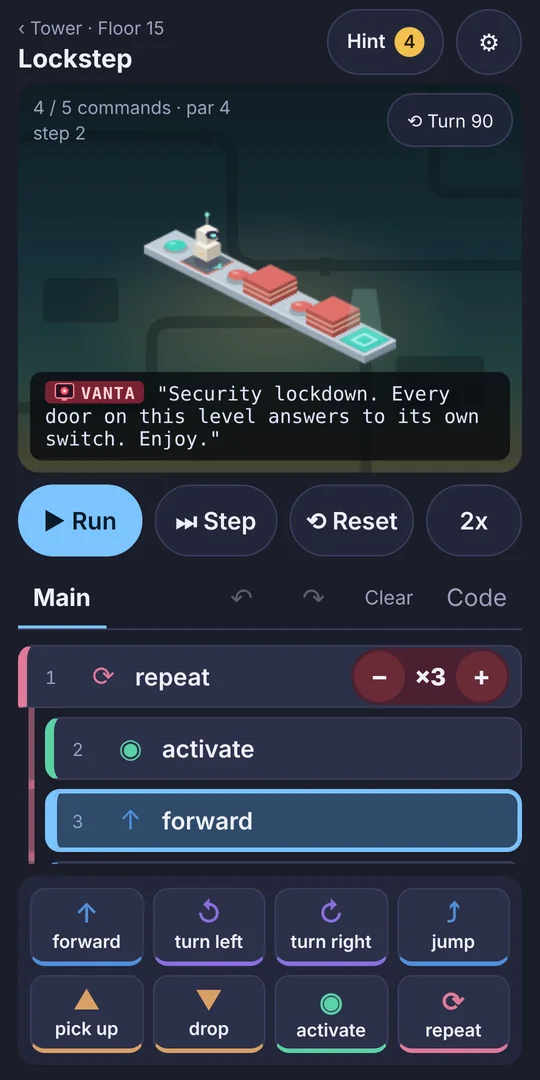
Loops do the heavy lifting 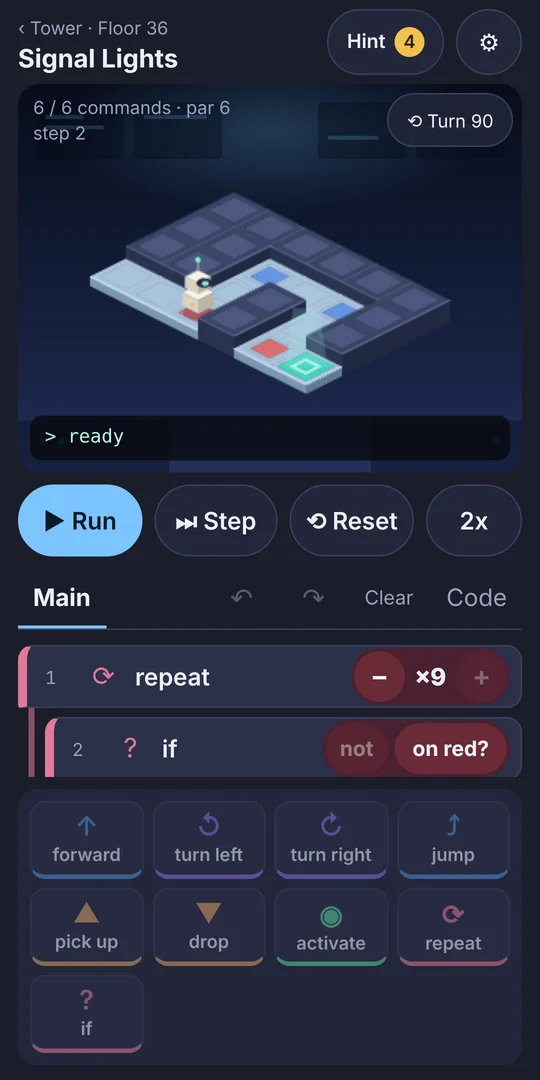
Make LoopBot think 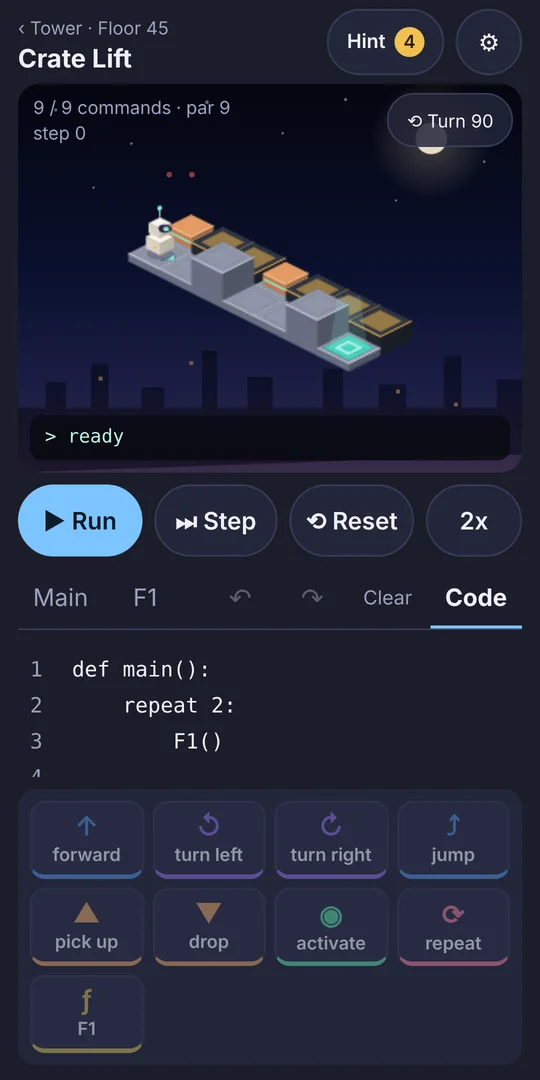
See the real code 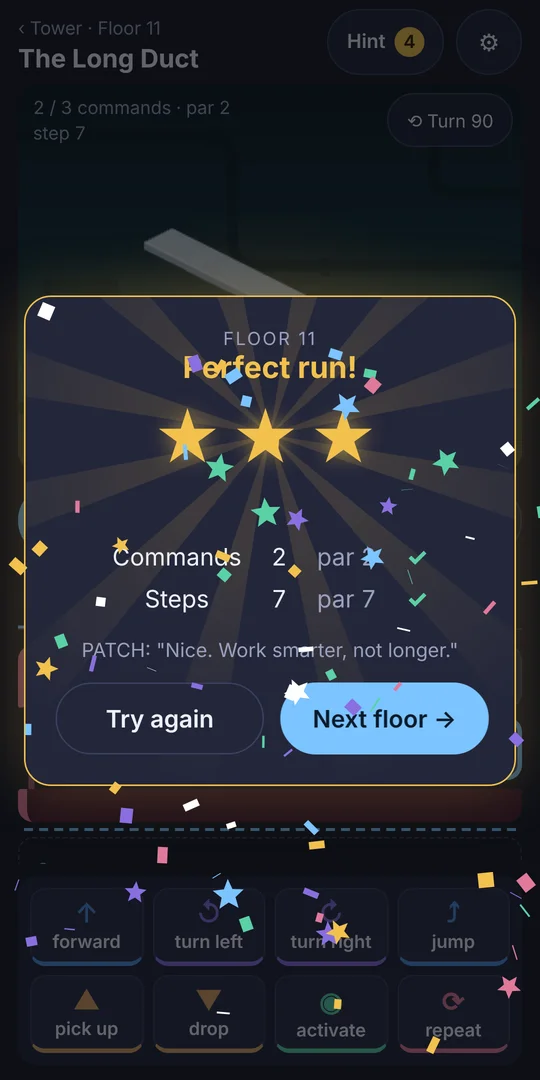
Three stars for a perfect program
Under the hood
How LoopBot was built
LoopBot is a one-person project, built with a modern web stack and shipped to the browser and to phones from the same code.
- React 19
- TypeScript
- Phaser 3
- Capacitor 8
- Vite
- Vitest
- dnd-kit
- GitHub Actions
- floors in Tower 1
- 50floors in Tower 1
- zones, one coding idea each
- 5zones, one coding idea each
- image or audio files for the game world
- 0image or audio files for the game world
- codebase for web and Android
- 1codebase for web and Android
One codebase, every screen.
The editor (blocks, drag and drop, undo, the code view) is a React app. The isometric board is a Phaser scene inside it. Capacitor wraps the same web build as a native Android app, with real phone haptics. The free demo on itch.io is the same build, limited to the first ten floors.
A tiny programming language.
LoopBot runs your program through its own interpreter, written in TypeScript. It steps through blocks one action at a time, so it can highlight the current block, pause, step, and stop runaway loops safely. There’s no eval anywhere. The Rooftop’s typed-code mode parses what you type back into blocks, with line-numbered error messages.
A deterministic simulation.
The game world is pure TypeScript with fixed rules, so the same program always gives the same result. That makes every floor testable.
Floors are data.
Each of the 50 floors is a small JSON file: the grid, tile heights, crates, switches, doors, the allowed blocks and the par. Adding a floor means writing a file, not code.
A solver that checks every floor.
A built-in solver searches for the shortest route and the smallest possible program for each floor. Automated tests run it on every floor on every change, so a floor can’t ship with a par that’s wrong or a shortcut nobody planned for.
Art drawn in code.
There are no image files for the game world. The isometric dioramas, the bot, its moods and the confetti are all drawn with code in Phaser, and the sky is CSS and SVG. The look is inspired by isometric puzzle games, with boards that turn in 90-degree steps.
Sound made from scratch.
Every chirp, click and fanfare is synthesised live with the Web Audio API. No audio files.
Fast and light.
The board engine loads in the background while you look at the menu, so the first screen opens fast (about 0.4 MB of JavaScript to start).
Built with AI as a teammate.
LoopBot was designed and built by Kevin working with Claude, Anthropic’s AI assistant: planning the requirements, writing and reviewing code, designing floors and testing them. Every change went through pull requests and automated tests on GitHub.
How a floor works
- Floor file (JSON)
- Solver checks par
- You build a program
- Interpreter runs it
- Board animates it
- Stars
Become a tester
Help launch LoopBot on Android
LoopBot is heading to Google Play, and I'm looking for testers. You'll get the full game early, free, on your Android phone. All I ask is that you stay in the test for 14 days and tell me what you think: what was fun, what was confusing, what broke.
Join the testAndroid 7.0 or newer. You'll need the Google account you use for the Play Store. I'll only use your email to invite you to the test.
Want a game or app like LoopBot?
I design and build games, web apps and mobile apps, from the first idea to the store listing. Let’s talk about yours, free.